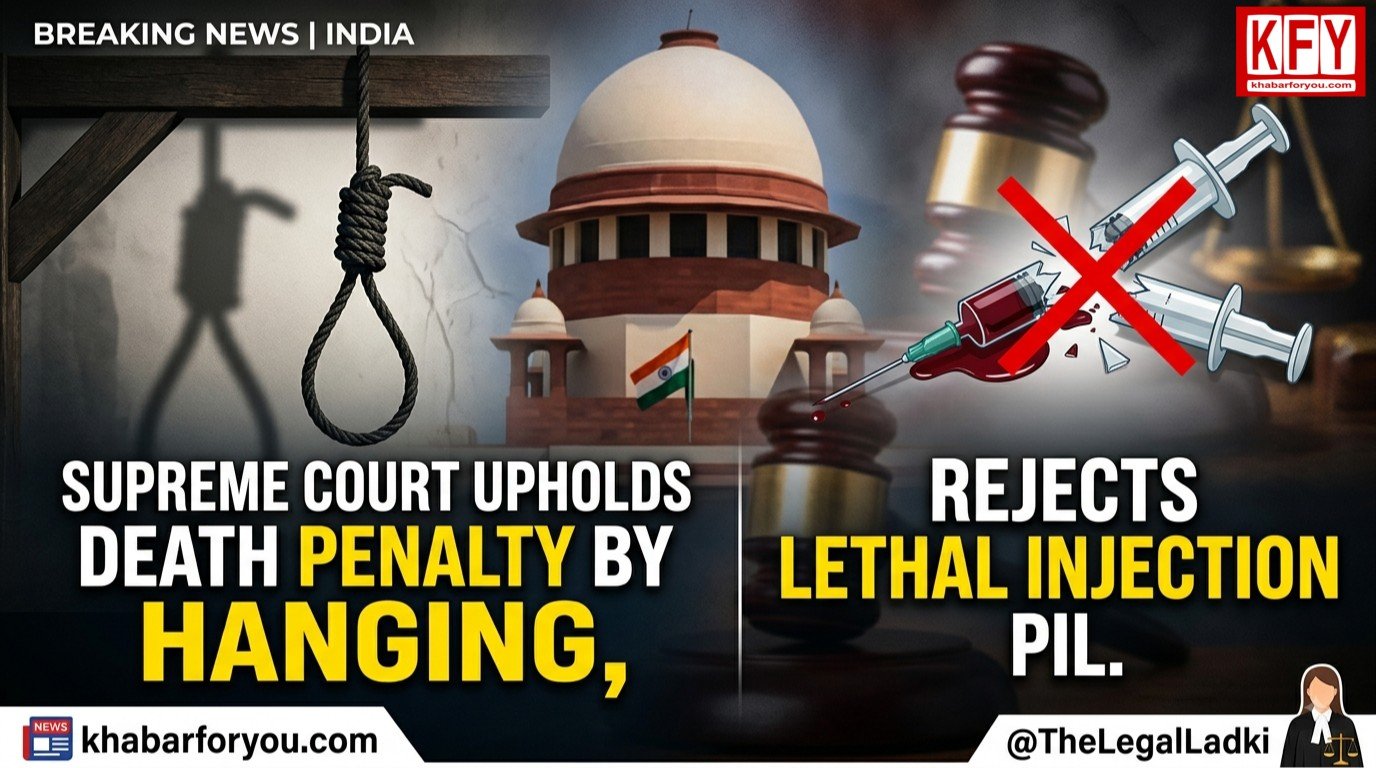
Supreme Court Upholds Death Penalty by Hanging, Rejects Lethal Injection PIL | KhabarForYou
- The Legal LADKI
- 18 Aug, 2026
- 98244

Email:-thelegalladki@gmail.com
Instagram:-@TheLegalLadki

In a landmark decision that deeply impacts the jurisprudence of state-sanctioned execution in India, the Supreme Court has unequivocally affirmed the constitutional validity of capital punishment by hanging. Dismissing a prominent Public Interest Litigation (PIL) that sought to abolish the classic "to be hanged by the neck until dead" protocol in favor of alternative, allegedly more humane methods, a Division Bench comprising Justices Vikram Nath and Sandeep Mehta ruled that hanging remains the statutory and constitutional mechanism for executing the death penalty in the country.
The verdict brings to a definitive close - for now - a lengthy legal battle surrounding the physical execution of justice, while simultaneously placing the responsibility for systemic judicial evolution back onto the shoulders of the Union Government.
The Anatomy of the Challenge: Humanity vs. The Protocol
The petition, filed by veteran advocate Rishi Malhotra, directly targeted Section 354(5) of the Code of Criminal Procedure (CrPC), which mandates that when a person is sentenced to death, the sentence shall direct that they be hanged by the neck until dead. Malhotra asserted that this centuries-old method violates Article 21 of the Constitution of India, which guarantees the fundamental right to life and personal liberty, a protection that the apex court has previously interpreted as encompassing the right to die with dignity.
In detailed submissions before the court, the petitioner argued that hanging is inherently barbaric, prolonged, and excessively painful. Presenting forensic data and comparative international studies, the petition outlined that execution by hanging causes immense bodily trauma, spinal fracture, and protracted asphyxiation, taking anywhere from 15 to 40 minutes for medical personnel to formally confirm cardiac and cerebral death.
In contrast, the plea advocated for modern, technologically driven alternatives such as lethal injection, electrocution, gas chamber exposure, or firing squad. Citing United Nations Economic and Social Council resolutions, the petition urged the court to adopt execution mechanisms that cause the least possible physical suffering. It further proposed a multi-option framework wherein death-row inmates could be granted the autonomy to choose their mode of execution - a procedure permitted in certain jurisdictions within the United States.
The Judicial Ratio: Why the Bench Refused to Intervene
Refusing to strike down Section 354(5) or refer the matter to a larger Constitution Bench, the apex court upheld the binding precedent established in the historic 1983 judgment, Deena alias Deena Nath v. Union of India. In Deena, a three-judge bench evaluated scientific evidence and concluded that hanging was quick, simple, and free from the terrifying lingering suffering associated with alternative methods like electrocution or gas chambers.
Justices Nath and Mehta observed that the petitioner had failed to produce overwhelming, undeniable scientific proof demonstrating that alternative execution methods are unequivocally less painful or more reliable than hanging. The court pointed out that global administrative data regarding lethal injection reveals a high incidence of "botched" executions, vascular collapse, and severe internal trauma caused by chemical paralysis, challenging the popular notion that lethal injection constitutes a pain-free death.
Consequently, the court found no compelling justification to depart from established legal precedent or to establish a larger bench to review earlier rulings.
A Striking Paradox: Court Displeasure vs. Policy Inaction
Despite upholding the legal status quo, the trial process revealed acute tensions between the judiciary and the executive branch regarding administrative inertia. During preliminary hearings, the Supreme Court had repeatedly voiced deep dissatisfaction with the Union Government's apparent reluctance to re-evaluate colonial-era execution protocols in light of modern medical science.
When Attorney General R. Venkataramani and Senior Advocate Sonia Mathur, representing the Centre, maintained that execution procedures belong strictly to the realm of legislative policy, the bench issued sharp oral observations, noting that the state appeared unwilling to evolve with time.
The Union Government rejected the suggestion of permitting condemned prisoners to choose their method of execution, stating in an affidavit that such an framework was "not practically feasible" within the Indian socio-legal and penal system.
The Judicial Escape Hatch: Future Scrutiny and Expert Review
While the apex court’s verdict closes the door on judicial intervention based on the current evidentiary record, it leaves a deliberate opening for legislative and scientific progression.
Writing for the bench, the court clarified that its judgment does not constitute the absolute final word on capital punishment execution methods in India. The justices explicitly noted that the dismissal of the petition must not be interpreted as foreclosing future constitutional challenges should fresh, compelling empirical, medical, or technological evidence emerge showing that the core findings of the Deena precedent have been invalidated by modern developments.
Crucially, the court indicated that the Central Government remains entirely free to establish a dedicated, high-level expert committee - comprising bioethicists, forensic pathologists, medical professionals, and legal scholars - to conduct a comprehensive evaluation of global execution methods.
Global Context and the Ongoing Debate
This judgment positions India among a selective group of nations that retain death by hanging as their primary execution framework, standing in contrast to international legislative trends advocating for complete abolition or advanced medicalized execution procedures. Legal scholars and human rights advocates remain divided over the outcome.
While proponents of the verdict argue that hanging provides a dependable, standardized, and mechanically swift method free from the commercial and pharmaceutical supply-chain vulnerabilities affecting lethal injection globally, civil liberties organizations contend that any form of state-sanctioned killing is incompatible with human rights principles.
For now, the legal framework remains firm. The Supreme Court has reaffirmed the constitutional validity of the noose, signaling that any operational evolution in how the state carries out its ultimate penalty must originate from executive policy reform and legislative action rather than judicial directive.
© 2023 Khabar For You. All Rights Reserved.
Business, Sports, Lifestyle ,Politics ,Entertainment ,Technology ,National ,World ,Travel ,Editorial and Article में सबसे बड़ी समाचार कहानियों के शीर्ष पर बने रहने के लिए, हमारे subscriber-to-our-newsletter khabarforyou.com पर बॉटम लाइन पर साइन अप करें। |
| यदि आपके या आपके किसी जानने वाले के पास प्रकाशित करने के लिए कोई समाचार है, तो इस हेल्पलाइन पर कॉल करें या व्हाट्सअप करें: 8502024040 |
#KFY #KFYNEWS #KHABARFORYOU #WORLDNEWS
नवीनतम PODCAST सुनें, केवल The FM Yours पर
Click for more trending Khabar
Leave a Reply
Your email address will not be published. Required fields are marked *
Search
Category